Pearson Edexcel · GCSE · Computer Science
Course version: 1CP2 · Version from Sept 2020
Be able to write programs that use logical operators (AND, OR, NOT)
Full specification wording
Operators: 6.5.3 be able to write programs that use logical operators (AND, OR, NOT)
This criterion requires you to write working program code, not merely to describe operators.
Checked against the Pearson Edexcel 1CP2 specification (opens in a new tab) on .
- Point 3 of 3
- 3 key terms
Study notes
From the checked teaching notes for this specification point.
The idea
This criterion requires you to write working program code, not merely to describe operators. In a language such as Python, AND, OR and NOT combine or invert Boolean expressions so a single condition can test several facts. AND is true only when both operands are true; OR is true when at least one operand is true; NOT reverses a Boolean value. For example, a program might admit a pupil when age >= 11 AND age <= 16, warn when score < 40 OR attendance < 80, and print a message only when NOT submitted. You must choose the correct operator for the intended logic, place it between valid Boolean expressions, and test the program with inputs that make each combined condition true and false. Assessment asks you to select or write code whose logic matches a stated rule, so trace each operand before deciding.
What earns the marks
- AND returns true only when both operands are true, so a rule requiring two conditions to hold together must use AND.
- OR returns true when at least one operand is true, so a rule allowing either condition to qualify must use OR.
- NOT inverts a single Boolean value or expression, turning true into false and false into true.
- Each operand of AND or OR must itself be a Boolean expression, such as a comparison, not a bare value.
- Correct code applies the operator to the intended conditions and produces the outcome stated in the question for every tested input.
Common mistakes and how to put them right
Using AND when the rule means either condition is enough.
Put it right by using OR so one true operand makes the whole condition true.
Using OR when both conditions must hold.
Put it right by using AND so the result is true only when both operands are true.
Placing NOT before a comparison without checking the resulting logic.
Put it right by tracing the inverted value and confirming it matches the intended rule.
Exam tips
- Rewrite the stated rule in words as 'both', 'either' or 'not' before choosing the operator.
- Trace one input that should pass and one that should fail through the full condition to confirm the operator.
- Check that each side of AND or OR is a complete comparison rather than a single value.
Try the lesson
The start of the Operators: 6.5.3 be able to write programs that use logical operators (AND, OR, NOT) lesson, made from checked teaching notes for this specification point.
Have a go first
A program sets score to 7. What is the result of the expression (score > 5) AND (score < 10)?
Listen
This criterion requires you to write working program code, not merely to describe operators. In a language such as Python, AND, OR and NOT combine or invert Boolean expressions so a single condition can test several facts. AND is true only when both operands are true; OR is true when at least one operand is true; NOT reverses a Boolean value. For example, a program might admit a pupil when age >= 11 AND age <= 16, warn when score < 40 OR attendance < 80, and print a message only when NOT submitted. You must choose the correct operator for the intended logic, place it between valid Boolean expressions, and test the program with inputs that make each combined condition true and false. Assessment asks you to select or write code whose logic matches a stated rule, so trace each operand before deciding. A strong answer earns marks for these points. AND returns true only when both operands are true, so a rule requiring two conditions to hold together must use AND. OR returns true when at least one operand is true, so a rule allowing either condition to qualify must use OR. NOT inverts a single Boolean value or expression, turning true into false and false into true. Each operand of AND or OR must itself be a Boolean expression, such as a comparison, not a bare value. A common slip: Using AND when the rule means either condition is enough. Instead, using OR so one true operand makes the whole condition true. Exam tip: Rewrite the stated rule in words as 'both', 'either' or 'not' before choosing the operator.
See it
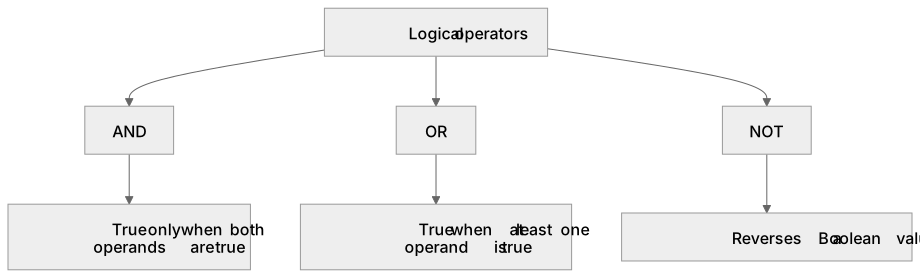
Key words
Say what each word means before you turn the card.
Combining conditions
Try answering aloud or in your head before turning the card.
Operator selection
Try answering aloud or in your head before turning the card.
Program testing
Try answering aloud or in your head before turning the card.
See every definition
- Combining conditions
- Using AND, OR and NOT to join or invert Boolean expressions so one condition tests several facts.
- Operator selection
- Choosing the correct operator for the intended logic and placing it between valid Boolean expressions.
- Program testing
- Testing the program with inputs that make each combined condition true and false.
Label the diagram
Some boxes have lost their names. Pick the right name for each number.
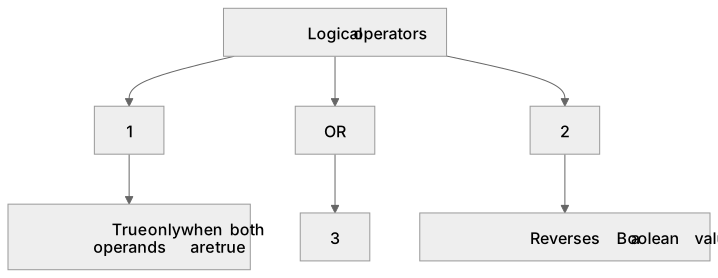
1Box 1
2Box 2
3Box 3
There is more to this lesson
The full lesson goes on to check your understanding and help you earn the marks. Create a free account to carry on, with your progress saved.
A week of Premium from your first lesson · Then the free plan continues · No card, no charge
Test your understanding of Operators: 6.5.3 be able to write programs that use logical operators (AND, OR, NOT)
Active recall beats re-reading. Take an instant quiz now to test what you’ve learned and lock it into long-term memory.
A week of Premium from your first lesson · Then the free plan continues · No card, no charge